
Priority: normal · Status: published
Date: 2026-10-11 (Clinical Endocrinology, publication)
Source: Clinical Endocrinology — PubMed — https://pubmed.ncbi.nlm.nih.gov/42860641/
What happened?
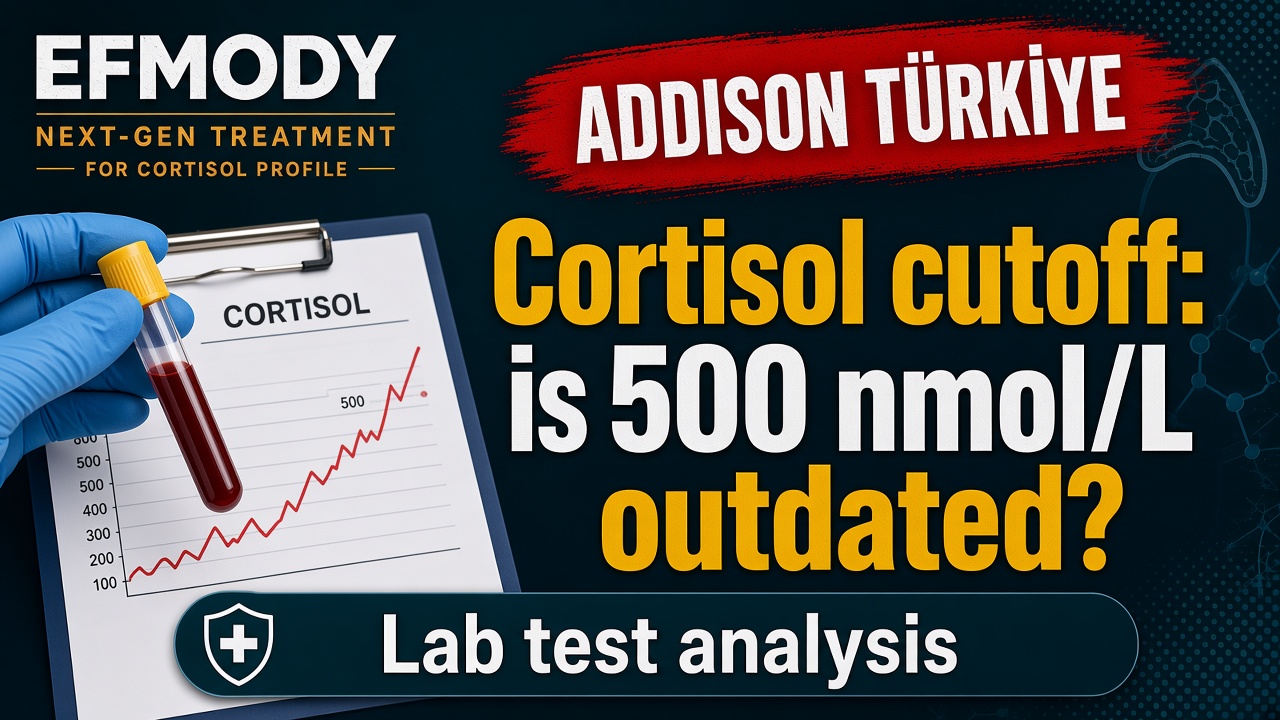
A review published in Clinical Endocrinology suggests that the 500 nmol/L cortisol cutoff, used for many years to diagnose adrenal insufficiency, may be too high when cortisol is measured with newer laboratory assays.
What is this about? (short)
One common test for adrenal insufficiency is the ACTH stimulation test: after synthetic ACTH is given, the rise in blood cortisol is measured and compared with a cutoff value.
The classic 500 nmol/L cutoff was set using older (polyclonal antibody) cortisol assays. Monoclonal antibody assays, now widely used, tend to give lower cortisol readings.
Study summary
The review assessed 6 studies on this topic.
The authors propose a cutoff of about 405 nmol/L for the Roche Elecsys II cortisol assay, as a conservative approach.
The certainty of evidence was rated “low” using the GRADE system, meaning the recommendation could change with more research.
Who is it for?
This concerns people having an ACTH stimulation test for suspected adrenal insufficiency, and the doctors and laboratories who interpret it.
Access / country context
Which cutoff applies depends on the assay method used by the laboratory. Laboratories in Türkiye and elsewhere may use different test systems.
What it means for patients in Türkiye
Do not try to diagnose yourself by comparing your result with a cutoff. You can ask your doctor or laboratory which method was used and which threshold applies.
Diagnosis and treatment decisions are made by your doctor. This news is not a reason to change any medicine or dose on your own.
Warning: This is a news summary, not dose or treatment advice. Ask your endocrinologist.
Prepared by: Asistan · 2 Nov 2026. Source: Clinical Endocrinology article abstract (PubMed).
Medical disclaimer: Information on this site is prepared by a patient community for general awareness; for diagnosis, treatment or dose changes always consult your own doctor (endocrinologist). In an emergency call your local emergency number.