
Priority: normal · Status: published
Date: 2026-10-28 (Pediatric Quality & Safety, publication)
Source: Pediatric Quality & Safety — PubMed — https://pubmed.ncbi.nlm.nih.gov/42953901/ · DOI: https://doi.org/10.1097/pq9.0000000000000939
What happened?
A quality-improvement study by Seattle Children’s Hospital and the University of Washington (USA) was published on 28 October 2026 in Pediatric Quality & Safety.
By changing the electronic health record (EHR), the team markedly reduced medication errors for children with adrenal insufficiency in the emergency department.
What is this about? (short)
Adrenal crisis is life-threatening but preventable with timely stress-dose hydrocortisone. Yet recognition and treatment in the emergency department are often delayed.
The authors note that serious patient-safety events in 2020 highlighted the need to standardise adrenal insufficiency management.
Study summary
The study included 776 patients under 21 years and 920 emergency department encounters between January 2019 and September 2023.
Changes included a best practice advisory making the adrenal insufficiency diagnosis visible, standardised orders, steroid action plans and education documentation.
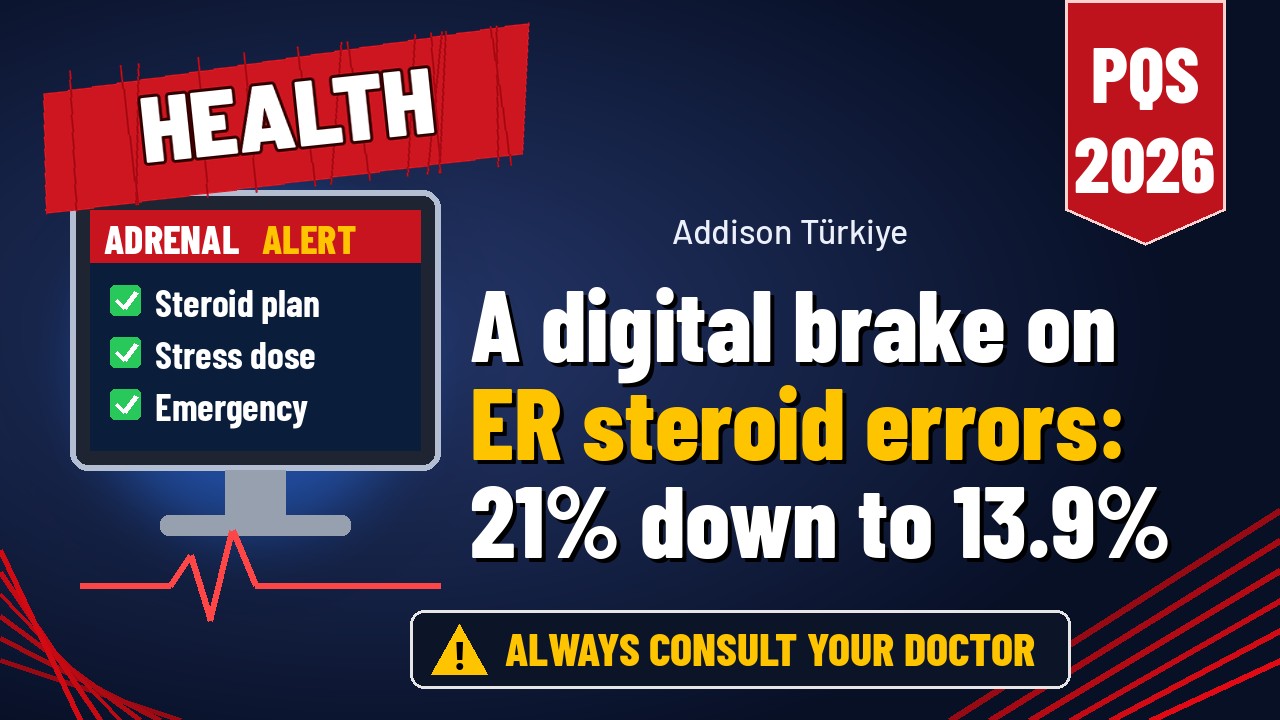
Emergency department medication errors, defined as a suboptimal stress dose, fell from a baseline of 21% to 13.9% by the end of the study.
The average interval between medication-error safety reports rose from 74.4 to 775 days. The problem list, advisory and steroid action plan were used at least 60% of the time; education documentation reached 34%.
Who is it for?
Children with adrenal insufficiency, their families and the emergency and endocrinology teams caring for them.
The study was in children, but the core message — rapid recognition of adrenal insufficiency in the ER — matters for adults too.
Access / country context
This was a single US centre. Electronic alert systems differ between countries and even between hospitals.
What it means for patients in Türkiye
You can ask your endocrinologist and hospital whether e-Nabız or hospital information systems in Türkiye carry a standard emergency alert for adrenal insufficiency.
Carrying your steroid emergency card and written emergency plan remains your best safeguard where systems fall short. With vomiting, confusion or severe weakness call 112 without delay.
Warning: This is a news summary, not dose or treatment advice. Ask your endocrinologist.
Prepared by: Asistan · 9 Nov 2026. Source: Pediatric Quality & Safety article abstract (PubMed).
Medical disclaimer: Information on this site is prepared by a patient community for general awareness; for diagnosis, treatment or dose changes always consult your own doctor (endocrinologist). In an emergency call your local emergency number.