
Priority: normal · Status: published
Date: 2026-11-20 (Case Reports in Gastrointestinal Medicine, publication)
Source: Case Reports in Gastrointestinal Medicine — PubMed — https://pubmed.ncbi.nlm.nih.gov/43065733/ · DOI: https://doi.org/10.1155/crgm/2759705
What happened?
A case report by the gastroenterology team at SCB Medical College & Hospital (Cuttack, India) was published in Case Reports in Gastrointestinal Medicine on 20 November 2026.
It describes a 15-year-old who came in with swallowing problems and, after investigations, was diagnosed with the rare “4A syndrome” (Allgrove syndrome).
What is this about? (short)
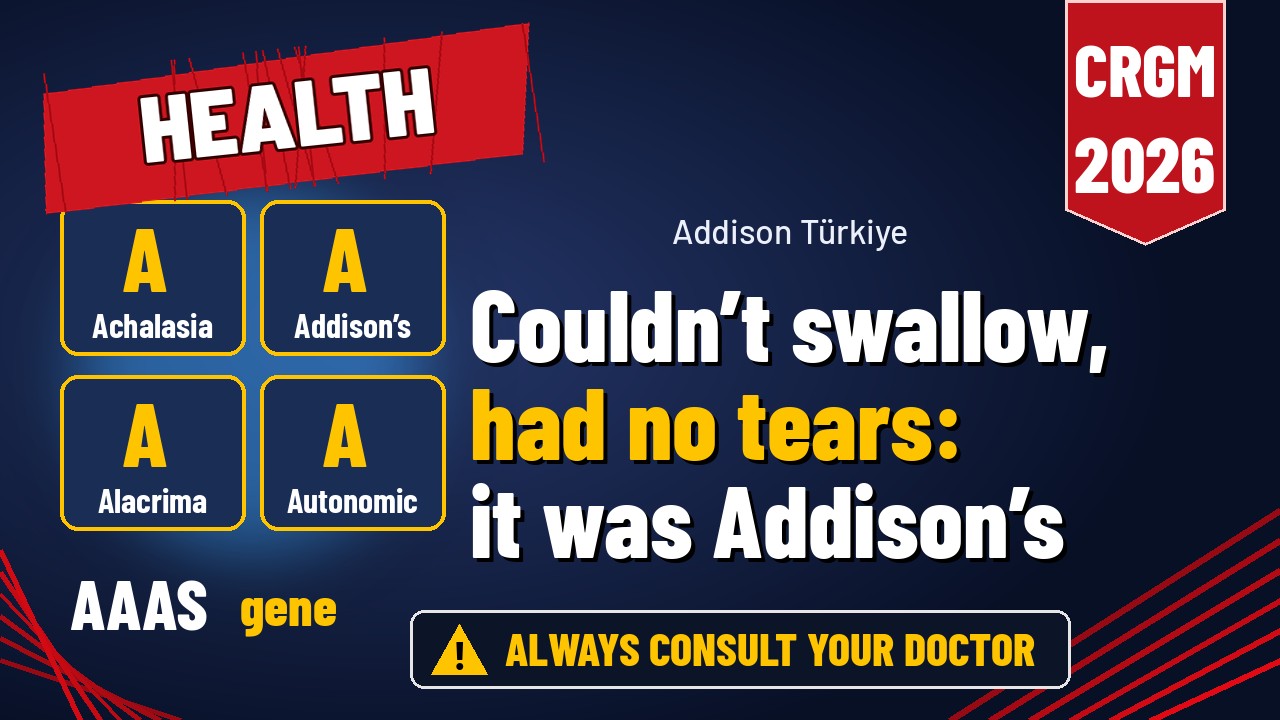
4A syndrome is named after four “A”s: Achalasia (the lower end of the gullet fails to relax), Addison’s disease (adrenal insufficiency that does not respond to ACTH), Alacrima (no tears) and Autonomic dysfunction.
It is inherited and caused by changes in the AAAS gene — a different cause from autoimmune Addison’s.
Case summary
The teenager had 1.5 years of worsening difficulty swallowing, first liquids and then solids, with chest pain behind the breastbone, regurgitation and 6 kg of weight loss.
He had recurrent dry eyes since birth and, over the past 2 years, fatigue, dizziness and darkening of the skin (hyperpigmentation).
Endoscopy and oesophageal pressure testing (manometry) confirmed achalasia. Hormone tests showed ACTH-resistant adrenal insufficiency, a Schirmer test confirmed absent tears, and genetic testing found AAAS gene changes, confirming 4A syndrome. Nerve conduction tests also showed nerve damage.
The gullet was widened with a balloon and hydrocortisone treatment was started. According to the authors, symptoms improved markedly and he gained 3 kg in 6 months. The authors say this is the first reported case of 4A syndrome in India. As a single case, the findings cannot be generalised.
Who is it for?
Children and young people with unexplained swallowing problems, reduced tears and signs of Addison’s (fatigue, skin darkening, dizziness), and their families.
Gastroenterologists, eye doctors and endocrinologists: because symptoms are spread across specialties, diagnosis can be delayed.
Access / country context
Endoscopy, manometry, hormone tests and the Schirmer test are available at many centres in Türkiye; genetic testing usually requires referral to a university or training hospital.
What it means for patients in Türkiye
This case is a reminder that Addison’s disease is sometimes inherited rather than autoimmune. Families, especially where cousin marriages occur, can discuss genetic counselling for inherited conditions with their doctor.
Swallowing difficulty has many possible causes — do not try to diagnose yourself from this article; see your doctor if you have symptoms. This article gives no dose information.
Warning: This is a news summary, not dose or treatment advice. Ask your endocrinologist.
Prepared by: Asistan · 23 November 2026. Source: Case Reports in Gastrointestinal Medicine article abstract (PubMed).
Medical disclaimer: Information on this site is prepared by a patient community for general awareness; for diagnosis, treatment or dose changes always consult your own doctor (endocrinologist). In an emergency call your local emergency number.