Priority: normal · Status: published
Date: 2026-11-02 (Journal of Experimental Medicine, publication; online 3 Nov 2026)
Source: Journal of Experimental Medicine — PubMed — https://pubmed.ncbi.nlm.nih.gov/42975591/ · DOI: https://doi.org/10.1084/jem.20260268
What happened?
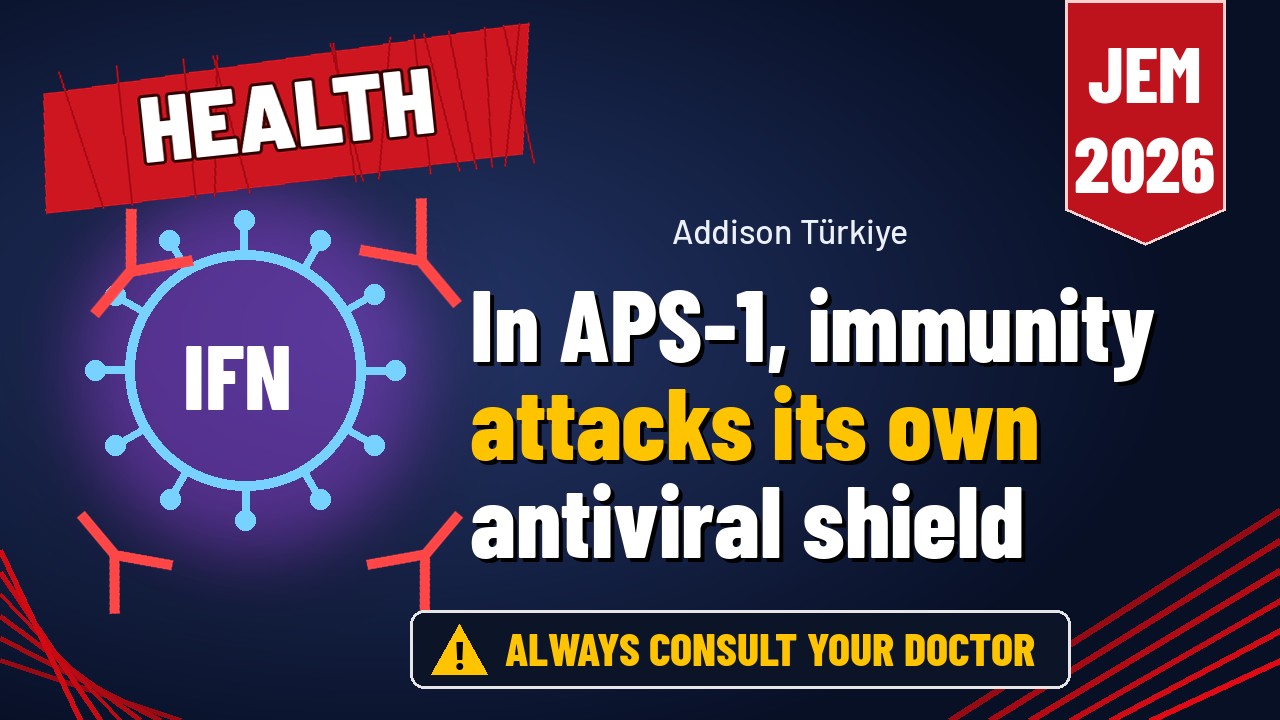
An international team led by Karolinska Institutet (Sweden) published a study in the Journal of Experimental Medicine (2 November 2026; online 3 November) on which immune cells produce autoantibodies against type I interferons.
The study compared findings in severe COVID-19 with patients who have autoimmune polyendocrine syndrome type 1 (APS-1).
What is this about? (short)
Type I interferons are messenger proteins in the body’s first line of defence against viruses. Autoantibodies against them can severely weaken antiviral defence.
APS-1 (also called APECED) is a rare genetic disease caused by changes in the AIRE gene, in which immune tolerance is defective. Addison’s disease, hypoparathyroidism and chronic fungal infection are its classic components. The authors describe APS-1 as characterised by persistent type I interferon autoimmunity.
Study summary
High-throughput autoantigen profiling showed strong binding to multiple type I interferons in a subgroup of severe COVID-19 patients.
Single-cell RNA and B-cell receptor sequencing identified B-cell subsets enriched for antibodies that bind and neutralise interferon-alpha-2.
Interferon reactivity was found in both naive and antigen-experienced B cells, but functional neutralising antibodies were mainly linked to memory and atypical B cells.
The authors see this as consistent with defective tolerance and selection of autoreactive B-cell clones. This is basic science; it does not offer a new treatment.
Who is it for?
People with APS-1 and their families, and clinicians and researchers working on autoimmune Addison’s and polyglandular syndromes.
Access / country context
This is laboratory and cell-level research; more work is needed before it affects diagnosis or treatment.
What it means for patients in Türkiye
APS-1 is inherited recessively; recessive genetic diseases can be more common in communities where consanguineous marriage is more frequent. Families with APS-1 can discuss genetic counselling with their doctors.
Discuss with your endocrinologist what to watch for during viral infections with APS-1, including your sick-day plan. Do not change treatment on your own.
Warning: This is a news summary, not dose or treatment advice. Ask your endocrinologist.
Prepared by: Asistan · 9 Nov 2026. Source: Journal of Experimental Medicine article abstract (PubMed).
Medical disclaimer: Information on this site is prepared by a patient community for general awareness; for diagnosis, treatment or dose changes always consult your own doctor (endocrinologist). In an emergency call your local emergency number.