
Priority: normal · Status: published
Date: 2026-11-16 (European Journal of Endocrinology, online ahead of print)
Source: European Journal of Endocrinology — PubMed — https://pubmed.ncbi.nlm.nih.gov/43035830/ · DOI: https://doi.org/10.1093/ejendo/lvag208
What happened?
A study by paediatric endocrinologists from Switzerland (Bern), the Netherlands (Rotterdam, Leiden) and Greece (Athens) was published online in the European Journal of Endocrinology on 16 November 2026.
It tried to predict whether children with congenital adrenal hyperplasia (CAH) are undertreated, using routine, inexpensive blood tests.
What is this about? (short)
CAH is an inherited condition in which the adrenal glands cannot make cortisol (and often aldosterone) from birth. The most common form is 21-hydroxylase deficiency. Children need lifelong hormone treatment.
Getting treatment right is hard: too little raises the risk of adrenal crisis and excess male hormones; too much can slow growth and cause weight gain. Monitoring today relies mainly on bone age and specialised steroid tests, which vary and need expert interpretation.
Study summary
At four European centres, 81 children and adolescents with genetically confirmed 21-hydroxylase deficiency were followed over three visits, giving 233 visits in total. Treatment status (optimal, under- or overtreatment) was classified by expert endocrinologists.
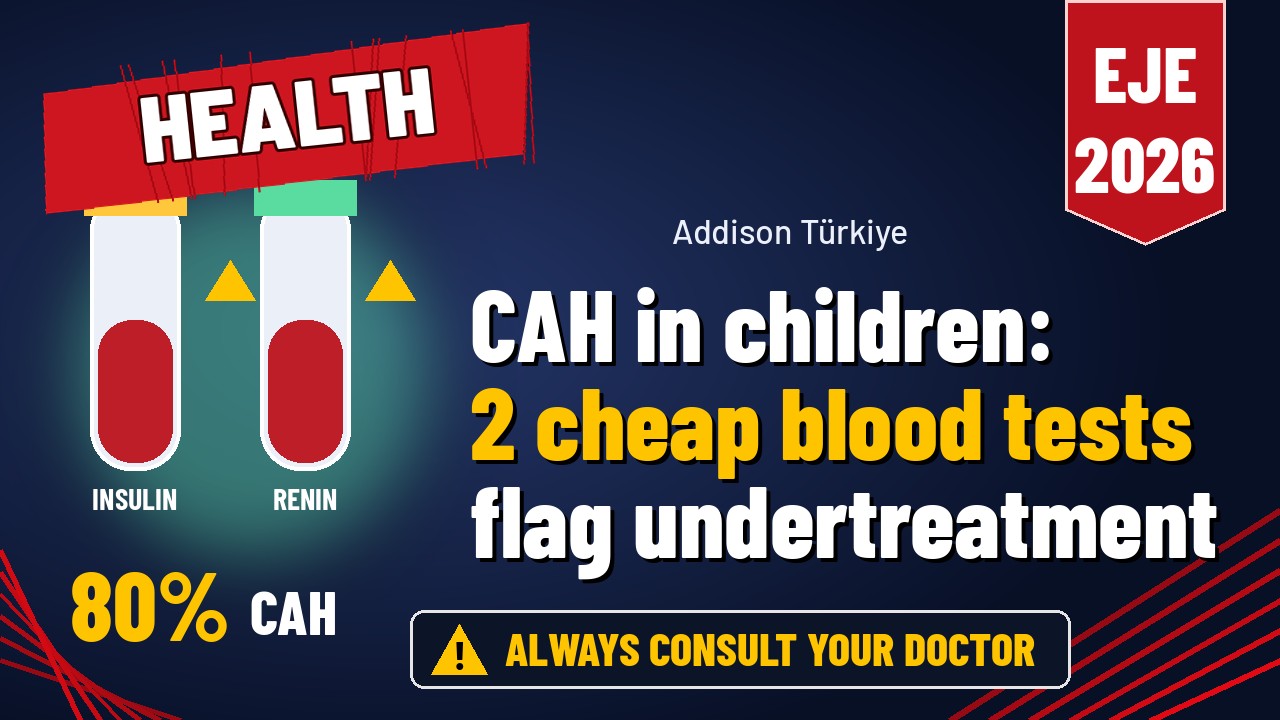
Undertreated children had higher fasting insulin and renin (an enzyme involved in salt-water balance), greater height and lower “good cholesterol” (HDL).
In the final model, insulin and renin remained independent predictors. At the chosen threshold, the score identified undertreatment with 71% sensitivity and 84% specificity — 80% correct overall.
The authors stress that both tests are cheap and widely available, and are also relevant to long-term cardiometabolic risk. The score needs validation in new patient groups and is proposed to complement, not replace, current monitoring.
Who is it for?
Children and adolescents with CAH, their families and paediatric endocrinologists.
Access / country context
Insulin and renin are routine tests available in many hospitals, including in Türkiye. The score is a research tool for now and is not yet in guidelines.
What it means for patients in Türkiye
In Türkiye, CAH is one of the conditions commonly followed in paediatric endocrinology clinics. This study points to a simpler, cheaper way of monitoring in the future.
Only your child’s paediatric endocrinologist can judge whether treatment is adequate; never change medicines based on a test result yourself. This article gives no dose information.
Warning: This is a news summary, not dose or treatment advice. Ask your endocrinologist.
Prepared by: Asistan · 23 November 2026. Source: European Journal of Endocrinology article abstract (PubMed).
Medical disclaimer: Information on this site is prepared by a patient community for general awareness; for diagnosis, treatment or dose changes always consult your own doctor (endocrinologist). In an emergency call your local emergency number.